



Twenty years ago, my husband, Russ, and I got married on a beautiful beach in the Dominican Republic.
After the wedding, I had this idea for our thank-you cards. I wanted postcard-style cards with a photo of the two of us running down the beach.
Cute. Romantic. Perfect.
All I needed was a sweet little saying to put across the front.
So naturally, I asked my brand-new husband for his opinion.
His suggestion?
“It’s easier as a couple.”
I literally dropped to the floor laughing.
He was completely serious, and could not understand why I didn’t think this was the romantic newlywed sentiment we should splash across a beautiful beach photo.
But here’s the funny part.
Twenty years later, “It’s easier as a couple” has become one of the most-used phrases in our marriage.
Making the bed together?
It’s easier as a couple.
Shovelling rotten grain out of a grain bin?
It’s easier as a couple.
Running around like crazy people during harvest?
It’s easier as a couple.
Grunting our way through the latest renovation project?
It’s easier as a couple.
Planning our next epic trip?
You guessed it.
It’s easier as a couple.
We still giggle every single time we say it.
Because as ridiculous as it sounded on a wedding thank-you card…
My husband was actually right.
And I think the same philosophy can apply to money.
Stop Thinking 50/50. Start Thinking Household.
One thing I see create unnecessary financial stress for couples is the idea that everything needs to be divided exactly 50/50.
My half of the mortgage.
Your half of the groceries.
My car payment.
Your utility bill.
I need to earn enough to cover my half.
But what happens when one person earns $60,000 and the other earns $150,000?
Their household earns $210,000.
The house they purchase, the vehicles they drive, the vacations they take and the lifestyle they choose are probably being decided based on that $210,000 household income.
So why would we make those decisions based on household income, and then suddenly expect the expenses created by those decisions to be split equally?
That can put a tremendous burden on the lower-income partner.
And it isn’t necessarily a win for the higher-income partner either.
You’re supposed to be on the same team.
Think About the Lifestyle Decision First
Imagine one partner makes significantly more than the other.
Together, the couple decides:
We can afford this house.
We can afford this vehicle.
We can take this vacation.
We can do this renovation.
Those decisions may make perfect sense based on their combined household income.
But perhaps the lower-income partner would never have independently chosen a house at that price, that vehicle, that vacation or that renovation.
Those choices only became realistic because of what the household earns together.
If that’s how the lifestyle decision was made, I think it’s worth asking why the financial responsibility suddenly becomes:
“Okay, now you owe 50%.”
Instead, the conversation can become:
What do WE want to accomplish?
What should WE be saving?
What lifestyle works for OUR household?
That’s a very different conversation.
What Could This Actually Look Like?
For a couple with predictable salaries, this can be incredibly simple.
You know your combined annual income.
Divide it by 12.
Now you know approximately what comes into the household each month.
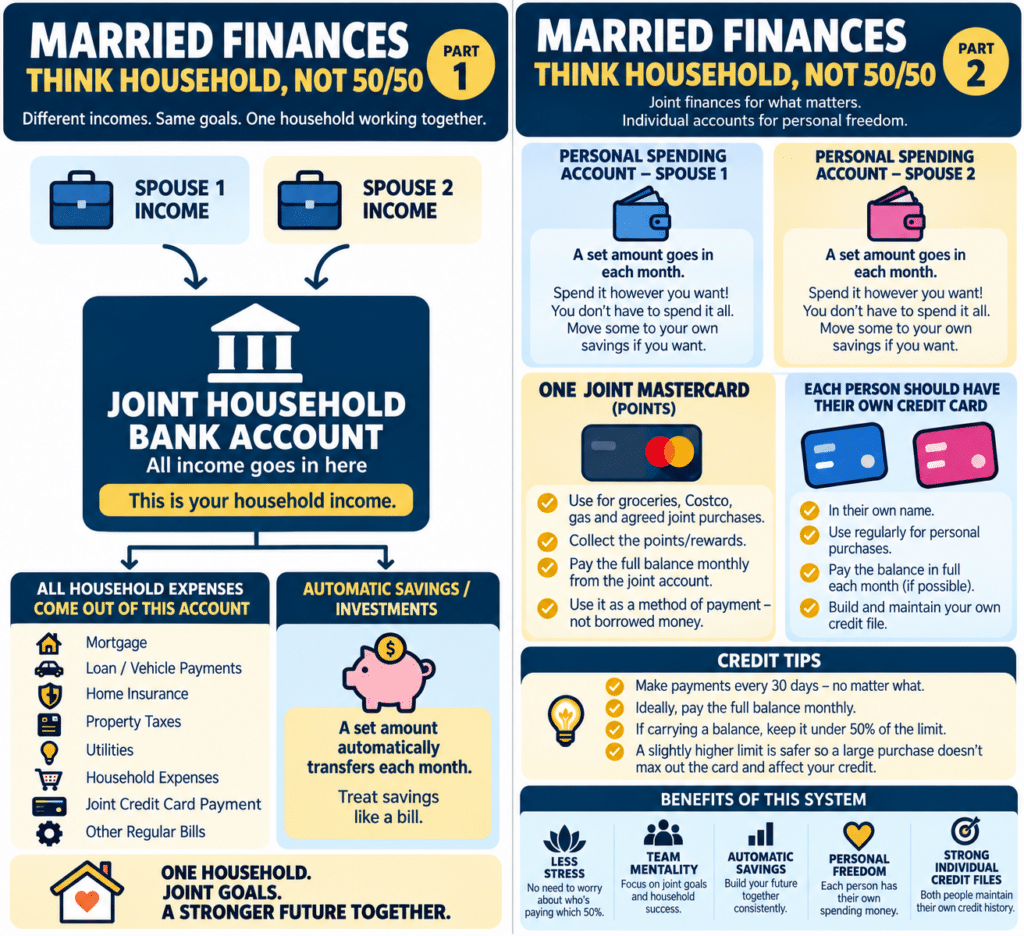
From there, you can create a simple system:
ONE joint household account.
Both incomes go in.
Mortgage, vehicle payments, property taxes, insurance, utilities and regular household bills come out.
You can have one joint points-earning credit card for groceries, Costco, gas and agreed-upon household purchases, and pay it off monthly.
Then automate a set amount every month into joint savings and investments.
And finally, each person receives an agreed-upon amount into their own personal bank account.
That’s your money.
Spend it. Save it. Buy something ridiculous with it. Let it accumulate.
You don’t need to explain every coffee, pair of shoes, golf purchase or whatever else you choose.
The household obligations and goals have already been looked after.
Joint Finances Shouldn’t Mean Losing Your Independence
This part is really important.
Combining your household finances does not mean one person should become financially dependent on the other.
Every adult should maintain credit in their own name.
I recommend that each partner have their own credit card, not simply an additional card on their spouse’s account.
Use it responsibly. Pay it monthly. Maintain your own established credit history.
As a general credit-management habit, make every required payment on time. Ideally, pay credit-card balances in full each month. If you do carry a balance, keeping utilization lower rather than running a card close to its limit can help protect your credit profile.
Each person can also maintain their own savings cushion if that’s important to them.
So now you have the best of both worlds:
Joint household finances. Joint goals. Joint savings and investments.
But also:
Individual spending money. Individual savings. Individual credit histories.
Being a financial team shouldn’t require giving up financial independence.
And Then Life Happens…
This approach can also make some of life’s bigger transitions easier to talk about.
Maybe someone takes a maternity or parental leave.
Maybe one person goes back to school.
Someone changes careers.
One partner temporarily works less.
You decide to take a big vacation.
You renovate the house.
One income suddenly jumps, or drops.
Instead of one person feeling:
“I’m not contributing enough.”
Or:
“I can’t afford my half.”
The conversation stays focused on:
What does our household look like right now, and what makes sense for us?
That’s a much healthier starting point for a financial conversation.
A Quick Note: I’m Not Throwing the Singles Under the Bus!
This conversation is obviously different when you’re single.
When you’re solo and 100% responsible for your own income, expenses, savings and financial goals, there isn’t another income to combine or another person to share the load with.
You’re the household.
You’re the team.
And every financial decision ultimately lands with you.
So this isn’t about saying being married or partnered automatically makes finances easier. It doesn’t.
Money and finances can be difficult in any partnership.
In fact, combining two people’s completely different relationships with money can sometimes make things more complicated.
Different incomes.
Different spending habits.
Different debt.
Different credit histories.
Different priorities.
Different ideas about what “expensive” even means.
I’ve been a mortgage broker for more than 20 years, and I take approximately 500 mortgage applications a year.
Believe me, we see every kind of financial situation.
We see different incomes, spending habits, savings habits, credit profiles, debt levels and completely different approaches to managing money.
And there is something I’ve noticed over the years.
The couples who seem to have less financial tension, live within their means and steadily build wealth often seem to have one thing in common:
They’re working toward the same goals.
It’s less about who technically paid for what and more about what they’re trying to accomplish together.
That’s not a scientific formula, and it certainly doesn’t mean every couple needs to organize their banking exactly the way I’ve described above.
It’s simply what I’ve personally seen work in my own marriage and what I’ve witnessed with many clients over the years.
When both people understand the household income, agree on the lifestyle, communicate about spending and are working toward the same savings and investment goals, money can start feeling less like a source of tension and more like another thing you’re tackling as a team.
Now, Is It Always This Simple? Absolutely Not.
Real life isn’t always two predictable paycheques arriving every second Friday.
My husband farms.
I’m self-employed in the mortgage business.
If there are two careers that could make the words “predictable monthly income” laughable, we’ve probably chosen them.
Our income can vary dramatically from month to month and year to year.
Because of that, we’ve actually maintained a fair amount of financial independence over the years.
But we’ve always had financial wellness checks with each other.
Where are we at?
What’s coming up?
What are we spending?
What are we saving?
What are we planning?
What needs attention?
And most importantly, there has never been an expectation that everything must be exactly 50/50 when our incomes aren’t 50/50.
The exact banking structure might look different for couples who are self-employed, have variable income, blended families, previous financial obligations or other unique circumstances.
The principle can still work even when the mechanics need to change.
It’s About Being on the Same Team
Has it always been perfect? Absolutely 100% not.
Money is stressful enough.
Marriage is complicated enough.
Life is expensive enough.
The goal doesn’t need to be making sure two people contribute the exact same number of dollars.
The goal can simply be:
Are we making financial decisions together?
Are we both protected financially?
Are we saving for our future?
Do we each have some financial independence?
Are we communicating openly?
Are we building the life we both agreed to?
Because ultimately, your finances shouldn’t feel like two roommates constantly calculating who owes whom $37.42.
You’re building a household.
You’re planning a future.
You’re navigating careers, kids, houses, mortgages, renovations, retirement, vacations and all the unexpected things life throws at you.
And apparently my husband figured out the secret 20 years ago on a beach in the Dominican Republic.
It just took me a while to appreciate his marketing skills.
It’s easier as a couple.
📞 Reach out anytime if you’re buying, refinancing or renewing together. We’ll look at the whole household picture with you.